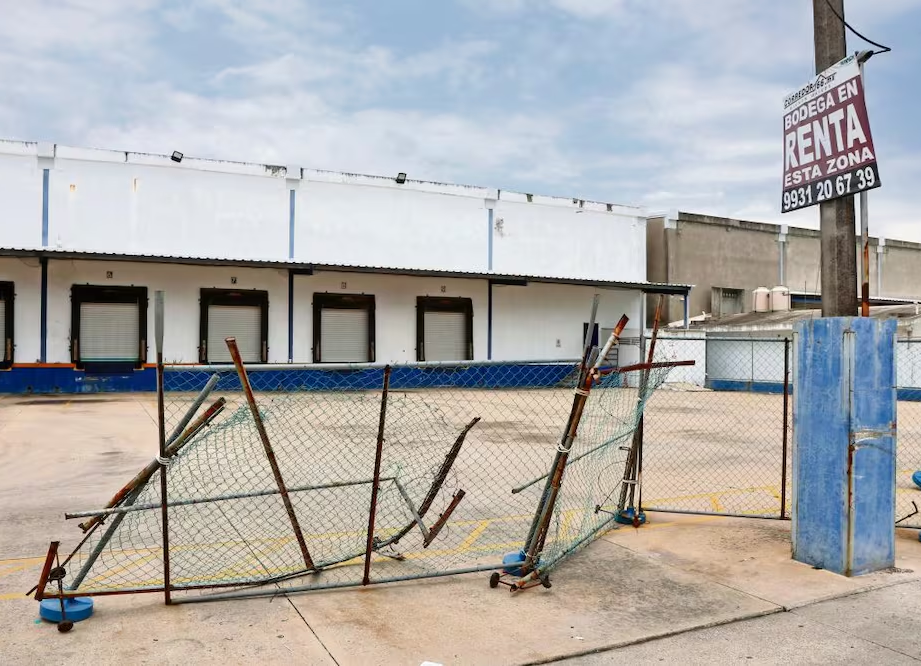

Along the Villahermosa-Cárdenas highway, several empty industrial buildings are available for rent. The scene is no different on the highway leading to Paraíso, where Pemex’s Olmeca Refinery is located. All along the road, specialized well-drilling equipment belonging to private companies sits idle in what appear to be open-air warehouses.
“The machines are just sitting here, they haven’t been paid, and they can’t be put to work. There’s no one to start them,” says a worker guarding a lot containing Baker Hughes equipment. The disillusionment of what was once “the Mexican Dubai” is evident throughout the state.
Alejandro Frías Díaz, president of the National Chamber of the Transformation Industry (Canacintra) in Tabasco, admits in an interview that, on average, companies were laying off a thousand people a month because they couldn’t pay them.
“There are no payments for 2024 invoices. If there are or were any payments… well, I don’t know, not those I know who are registered with Canacintra. In general, there are no payments in the drilling sector. 2025 is coming, and a massive layoff is beginning. In Tabasco, a thousand people were laid off, and in Ciudad del Carmen, about 500. We registered a total of 22,000 layoffs in 2025 alone,” Frías states.
Before this edition went to press, Frías updated by phone that some companies considered “priority” for Pemex’s operations in Tabasco have already begun receiving payments for 2024 invoices. The payments started coming in just at the beginning of last week.
Pemex’s debt to Tabasco suppliers, as of the beginning of March of this year, amounted to 400 billion pesos in outstanding invoices. For 2024 alone, outstanding invoices totaled 30 billion pesos, according to data from Canacintra (National Chamber of the Transformation Industry).
“Every sector is struggling. You go to the neighborhoods, all the apartments are for rent, there are entire office buildings empty, the large offices of Baker Hughes and Halliburton are gone, and now they barely occupy a single floor. Businesses that provided various services, that rented industrial buildings, warehouses, the hotel industry—everyone has been affected,” admits Luis Carlos Dupeyrón, a businessman and representative of the PAN (National Action Party) in Tabasco.
One example, according to local journalists, is the Usuma Tower—located across from La Choca Park in the Tabasco 2000 industrial zone—known as the most opulent building in Tabasco. The Usuma Tower has been under construction for several years, under the promise of being Tabasco’s first skyscraper.
Workers haul rebar in half-empty trucks. According to local journalists, Pemex is investing in the Usuma Tower by leasing several floors to it, thus separating it from its lease agreement with the Torre Empresarial, located on Paseo Tabasco Avenue.
The Torre Empresarial is owned by one of the companies in which Senator Adán Augusto López, former governor of Tabasco, is a shareholder.
Today, Pemex’s “pyramid” is adorned with banners from workers denouncing the oil company for “plunging them into poverty” with a reform to the collective bargaining agreement that prevents them from accessing their pensions.
“It would be good if Pemex paid the contractors already. It’s been a very difficult Christmas for Tabasco business owners and, therefore, for all families,” says a parking attendant in front of the Usuma Tower.
Several restaurants, cafes, and bars in the area are maintaining their prices as they were during the business boom.
“They don’t want to lower their prices, but there are fewer customers now,” says a waiter.
Source: eluniversal